
What to describe when you request help
- A provider has observed roots in the line.
- The same sewer obstruction keeps returning.
- Earlier inspection identified a joint or damaged section.

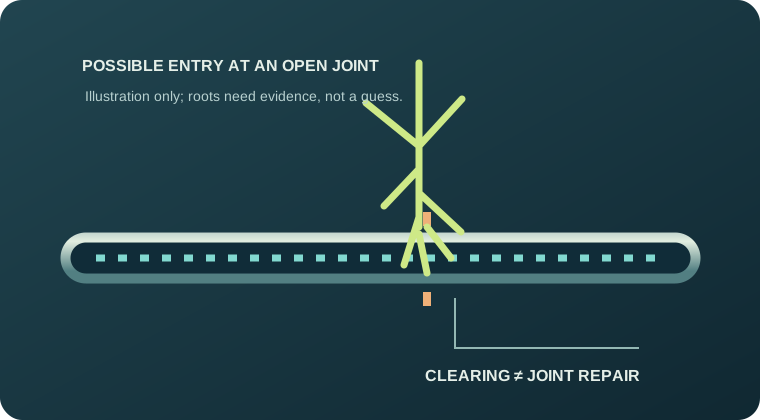
Ask for the recorded location and pipe condition if roots or the same blockage return. The diagram illustrates a possible mechanism, not the condition of your sewer.
Simplified educational illustration · not an on-site diagnosisA tree nearby is not a diagnosis
Mature landscaping does not prove that roots are inside a sewer. Ask for inspection findings rather than attributing every old-house blockage to trees. Debris, grease and other conditions can also interfere with drainage.
Clearing and entry-point repair are different
Mechanical cutting or another suitable method may remove an obstruction. It does not necessarily seal the opening that admitted roots. Ask the provider what was cleared and whether inspection shows a continuing defect.
Ask about recurrence
Find out what would justify monitoring, another cleaning, a localized repair or a larger replacement. The recommendation should relate to the observed condition and location, not a blanket promise that one treatment is permanent.
Avoid improvised chemical treatment
Do not add root-control chemicals without confirming the product label, system suitability and local requirements. Tell the provider about any chemical already used before equipment enters the line.
Roots removed before, but the sewer is blocked again
Tell the provider when roots were last removed and whether there is a saved camera recording. Root clearing can restore flow while leaving the entry point unresolved. Request the location and condition of any affected joint or pipe section before discussing repair. A tree in the yard alone is not evidence that roots caused the current blockage.
Questions before booking
Do roots always require full sewer replacement?
Not automatically. The location, extent and condition matter. Ask for evidence and available options.
Can root clearing be permanent?
Removing roots may not correct the entry point. Discuss the expected follow-up and any structural issue found.