
What to describe when you request help
- Shower or bathwater takes longer to drain.
- A bathroom sink repeatedly blocks.
- The tub receives wastewater when another fixture runs.
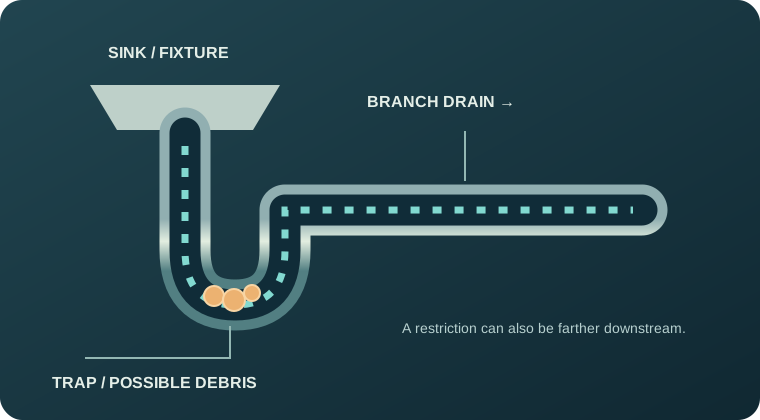
Debris near a trap is one possibility. A clear opening does not rule out a restriction farther downstream. Describe the fixture and any other affected drains.
Simplified educational illustration · not an on-site diagnosisHair removal and deeper clearing are different tasks
A visible hair collection near an accessible strainer is not the same as an obstruction beyond the fixture. If a minor issue keeps returning or water backs up elsewhere, arrange assessment instead of repeatedly adding chemicals.
Protect the room during assessment
Keep the route to the bathroom clear and tell the provider about delicate finishes, recent remodeling and previous access work. Do not dismantle hidden plumbing or use a power auger without suitable training.
Record what changes with water use
The provider will want to know whether the drain backs up only during a shower, when the toilet flushes or when the washer drains. That history is more useful than a guess that every bathroom problem is a hair clog.
Shower standing water and a slow bathroom sink
A shower holding water can involve hair and residue near the drain, but simultaneous toilet or tub backups need a broader assessment. A slow sink with no visible obstruction can still have a restriction farther along the branch; a venting or pipe-condition issue may also require investigation. No visible hair does not prove that the drain is clear.
Questions before booking
Why does the bathtub fill when the toilet flushes?
The fixtures may be backing up through a shared drain route. Stop adding water and request assessment of the connected line.
Should I use a stronger cleaner after the first one fails?
Do not combine products or repeatedly add chemicals. Follow the label, stop using the fixture if it is backing up and tell the provider what was used.