
The short answer
Write down the sink, shower, tub, toilet and appliance symptoms you have already observed. Do not run more water to test a system that is actively backing up. One slow sink may involve a fixture or branch, while several affected fixtures can indicate a restriction farther downstream.
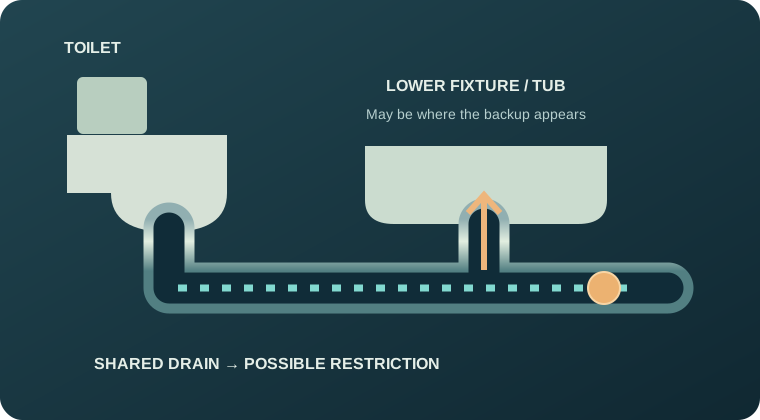
A shared restriction can make a tub or shower back up when a toilet is flushed. Stop adding water to an active backup; describe the full pattern to the provider.
Simplified educational illustration · not an on-site diagnosisLook for a connection between fixtures
If a toilet flush causes water to rise in the tub, say exactly that. If the washer pumps out and a floor drain overflows, report the sequence. These descriptions help the provider decide what access and equipment to bring.
Do not choose the repair from the symptom alone
A main-line symptom does not prove roots, a collapsed sewer or a public-main problem. The provider needs to locate the restriction. If several properties are affected or sewage appears at a public manhole, use your city’s reporting route as well.
Prepare for the visit
Gather previous clearing dates and camera reports, identify the property owner or manager and tell the provider about any chemical used. Ask what the visit covers before authorizing additional inspection or repair.
A slow drain with no visible clog
Not seeing hair or debris at the opening does not rule out a restriction farther down the drain. Describe how long drainage takes, which other fixtures are affected and any gurgling you have already noticed. Do not diagnose a vent fault or main-line blockage from a slow sink alone. The provider can distinguish a fixture problem from a shared drain or pipe-condition concern.
At a glance
| Situation | Next step | Keep in mind |
|---|---|---|
| One slow sink; other fixtures normal | Describe the fixture and any earlier attempts. | Fixture or branch assessment |
| Two toilets and a tub affected | Stop adding water; report all affected fixtures. | Shared line / main-line assessment |
| Wastewater at a public manhole | Keep clear and report to the utility. | Public-system reporting |
Related service
Sources & reading notes
General homeowner orientation. This guide does not replace an on-site assessment, product label or city-specific utility instruction.