
The short answer
Stop using the affected fixture. If water is rising from another drain or several fixtures are affected, avoid using connected plumbing as well. Keep people away from wastewater and wet electrical equipment. A bowl of standing water alone cannot tell you whether the obstruction is near the fixture or farther downstream.
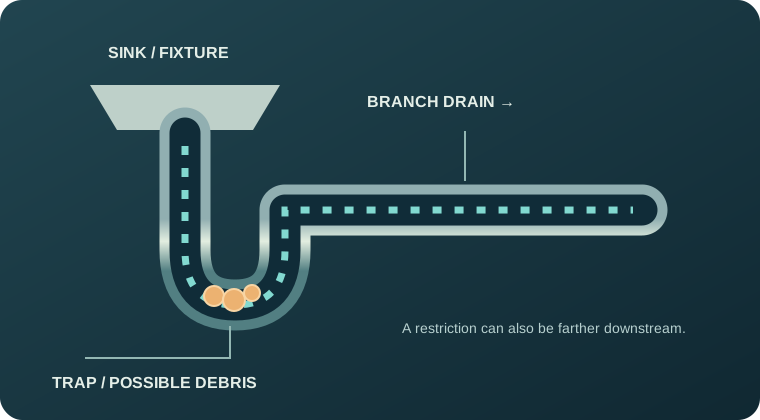
Debris near a trap is one possibility. A clear opening does not rule out a restriction farther downstream. Describe the fixture and any other affected drains.
Simplified educational illustration · not an on-site diagnosisCheck the pattern without another water test
Write down what you have already observed: a slow shower, a sink full of water, a toilet that makes the tub rise, or a washer standpipe overflow. Do not flush, start an appliance or turn on taps to reproduce an active backup. Share the sequence with the provider.
If a chemical cleaner has already been used
Tell the provider the product name, approximate amount and when it was added. Do not mix drain products or add bleach, vinegar or another chemical. Follow the product label; do not plunge after using a cleaner because trapped chemical can splash back. Do not dismantle a chemical-filled trap.
When to arrange drain assessment
Request fixture or branch help for an isolated sink or shower problem, and describe every affected fixture when a shared line may be involved. Ask who will perform the work and what the appointment includes. If the issue is at a public manhole or affects several properties, use the city utility reporting route too.
At a glance
| Situation | Next step | Keep in mind |
|---|---|---|
| One shower holds water | Stop using it; describe existing symptoms | Fixture or branch assessment |
| Tub rises when a toilet is flushed | Stop adding water to the backup | Shared-line symptoms |
| Chemical remains in standing water | Name the product; avoid plunging or mixing | Follow the label and tell the provider |
Related service
Sources & reading notes
General homeowner orientation. This guide does not replace an on-site assessment, product label or city-specific utility instruction.